From Sea to Tomb to New Life
Explore how the Red Sea crossing, Jesus' resurrection, and baptism form one saving movement—ancient mornings that invite us into present deliverance and new life.
Why does the Red Sea crossing matter for Christians today?
The Israelites’ passage through the sea is more than a national escape; it’s the founding image of God delivering a people from death into life. Picture the last line of Israelites crossing, the surf on either side like walls, and then—before the final step—those waters rising again. They weren't just passing through; they came up out of the sea onto the far shore and continued on—an image that reshapes what deliverance looks like.
"Then Moses stretched out his hand over the sea, and the Lord drove the sea back by a strong east wind all night and made the sea dry land, and the waters were divided."
— Exodus 14:21
Deliverance is communal and decisive.
Behind the Words: God didn’t rescue a lone wanderer; He delivered a people with signs that shaped their identity. The Exodus narrative meant to show Israel’s sudden reversal: from threat to safety by God’s direct intervention.
- Hear this: salvation isn’t solely private—God’s acts forge a redeemed community.
Every step on that sand mattered. When we read Exodus we must remember the pillar of cloud and the pillar of fire—those companion images that walked between Israel and Egypt. That detail is more than spectacle: it names God’s presence as both protector and radiant guide. Exodus describes how the pillar of cloud moved to stand between Israel and the Egyptians (Exodus 14:19–20), a vivid reminder that protection often comes as a visible presence, not as abstract comfort.
The Heart of It: God’s saving acts often come at the edge of impossibility, turning our trapped endings into new beginnings.
Try This: Imagine yourself at the water’s edge—bills, grief, a job loss—feet in the wet sand. Feel the panic. Now picture a pillar of light forming between you and what chases you. What is one small step of obedience you could take toward the promised shore?
We must not spiritualize the Exodus into mere metaphor and lose its social and political punch. God’s salvation in history has social consequences: a rescued people receive a covenant and a future. Yet the story also models spiritual formation: we pass through what kills us so we can be formed into people who remember and worship.
The ancient ritual pools—mikva'ot—with their worn center steps offer a human detail from history: people descending into water and rising on the other side, marked by the groove of many feet. That worn groove tells a truth: generations have practiced entering death-like waters and emerging alive. We stand in that groove when we recall baptism and the way God shapes covenantal memory.
How does Jesus' resurrection connect to the Passover and baptism?
The New Testament frames Jesus’ rising on a morning "while it was still dark" as more than chronology; it's theological timing. Scripture places Mary Magdalene at the tomb "early, while it was still dark," echoing the Exodus timing when Israel rose from the sea before dawn. Read together, these moments share a repeated motif: the same time, the same dawn, the same movement from burial to life.
"Now on the first day of the week Mary Magdalene came to the tomb early, while it was still dark, and saw that the stone had been taken away from the tomb."
— John 20:1
Christ's resurrection is the hinge between Israel’s history and our baptismal identity.
Behind the Words: The resurrection happens during the Passover timeframe—linking Jesus’ victory over death to the festival of liberation. In first-century Jewish thought, timing and festival context mattered; a rising at Passover morning carried theological weight.
- Try This: When we baptize, we join that same morning rhythm: buried with Christ and raised to walk in newness.
Here is a striking claim: in God's eyes, these events belong together. That is a hard saying. It confronts us with a divine logic where the Exodus, the resurrection, and our baptisms are not three separate miracles but one movement of God to bring life from what should have killed us.
What do we do with that? First, notice the continuity. Paul tells us that our ancestors passed under the cloud and through the sea—events intended by God to prefigure something greater. The gospel uses Exodus imagery to show that Jesus is the one who completes Israel’s story: where Israel walked into safety, Christ walked out of death into life.
The Heart of It: The resurrection reframes Israel’s past as the roadmap for the church’s present—God completes what He began.
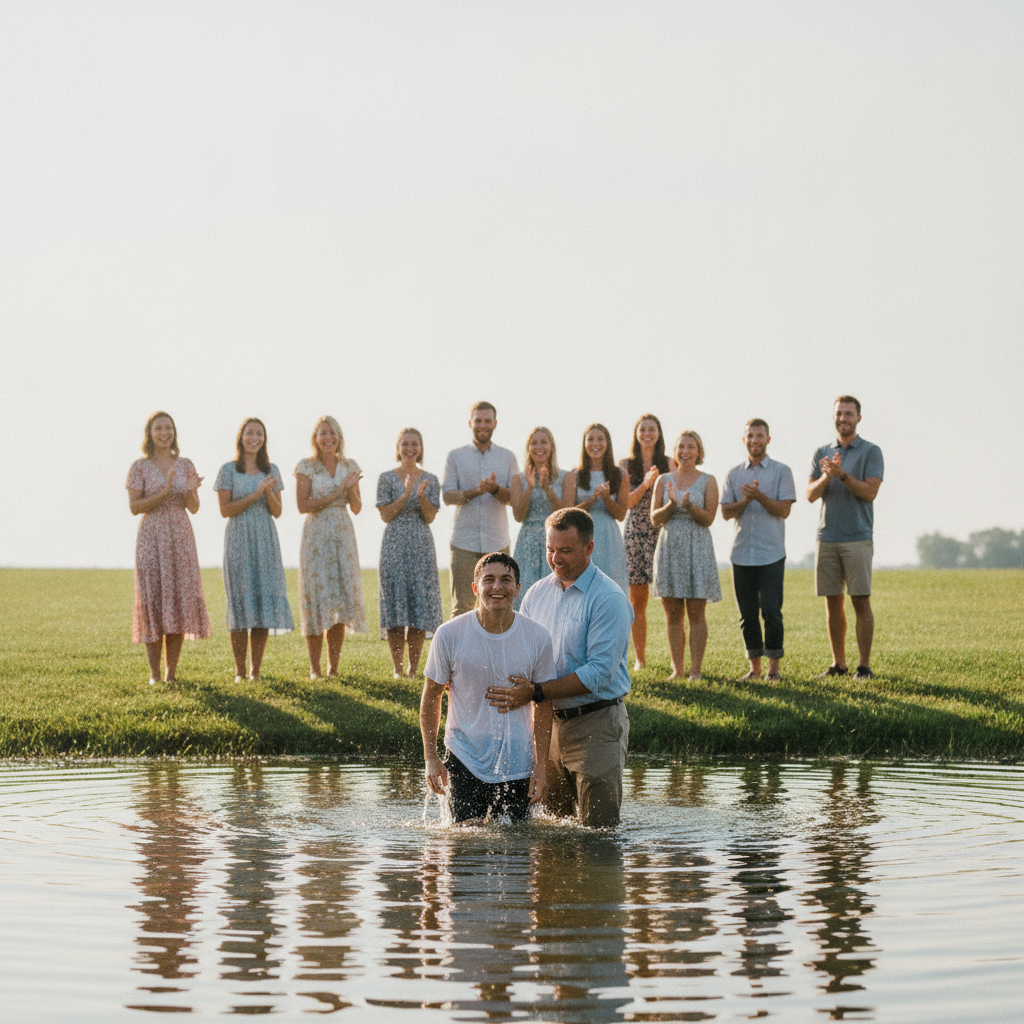
Try This: Picture a baptism: a person kneels, the water envelopes them, and they rise. Imagine now that same rising timed with the first light, the community singing a Passover hymn as the baptized one steps up—tied to both the sea and the tomb. How might your heart respond differently to baptism if you saw it as the echo of those two mornings?
Don't sentimentalize baptism as only symbolic ritual. Baptism is a participatory event: we are reckoned dead to sin and alive in Christ. Picture an ancient immersion pool with a central stair groove—this is not abstract. It is the embodied practice of dying and rising together.
How should baptism shape how we live after we rise?
We often treat baptism as an initiation ritual—important, yes—but what if it’s more like a daily orientation? Consider the pattern: the Israelites came up from the sea, Jesus rose from the tomb, and we rise after baptism. That triad is meant to be more than liturgical symmetry; it’s an existential map for ongoing discipleship.
"For I do not want you to be unaware, brothers, that our fathers were all under the cloud, and all passed through the sea."
— 1 Corinthians 10:1
Baptism is the beginning of living as a people already delivered.
Behind the Words: Paul ties Israel’s experience to Christian baptism to remind the church we are part of a saving story that continues.
- Try This: Live as one who has already been rescued—act differently in relationships, finances, fears.
Imagine the immersion pool with steps worn down the middle. People descended and ascended in the same place for generations. Baptism does that to us: it places our life inside a story larger than our failures. You don’t only get dunked; you are invited to live from that resurrection center every morning.
What does that look like on a Tuesday? It is choosing mercy over resentment when an email wounds you. It is refusing despair when medical results are poor. It is offering your last resources when scarcity screams. Small acts—but they are the vocabulary of a people who have risen.
The Heart of It: Baptism isn’t a certificate; it’s an orientation that reorders how we face death, fear, and the future.
Try This: The next time bitterness rises, imagine the pillar of cloud between you and what chases you. Picture the worn stair in the immersion pool. Take one concrete action—an apology, a phone call, a generous gift—that shows you’re living from the other side.
A common misunderstanding is to treat baptism as magic—an event that guarantees smooth lives. The gospel promises transformation, not immunity. We still walk valleys; the difference is whom we follow through them.
Behind the Words: To say that in God's eyes these events belong together is to link Exodus, the resurrection, and baptism as single acts in God’s redemptive economy.
The Heart of It: God sees His saving work as one continuous act—what He began for Israel He completes in Christ and applies to us in baptism.
Try This: Sit in silence at dawn. Name one fear that feels like a sea before you. Speak it aloud, then picture that fear divided like the waters. Let your prayer be, "Lord, make this deliverance real for me today." If possible, attend a baptism and let the imagery sink into your imagination.
We must also resist equating timing with inevitability. The detail about "the same time, the same day" is theological poetry, not a mechanical timetable. God’s timing reveals His purposes, and our call is to live within that revealed pattern.
We learn from those two dawns that God’s rescue moves through history and into our ordinary mornings. The pillar of cloud and fire that stood between Israel and Pharaoh, the tomb’s stone rolled away while it was still dark, the worn steps of an immersion pool—these are not museum relics. They are living signs that death does not have the final word.
We are invited to step into that trajectory: cross from fear to trust, from defeat to resurrection, from lone shame to communal newness. So when morning finds you still in the dark, remember the pattern. God often does His deepest work before the sun fully rises. Live as people who have already been raised: tender toward one another, bold against despair, and unashamed to step into the water when God calls.
May we rise together.
Key Takeaways
- Understand the connection between historical biblical events and personal faith.
- Recognize the significance of baptism as a representation of new life.
- Explore the themes of transformation and divine intervention in your life.
- Reflect on the importance of faith during spiritual journeys.
Notable Quotes
"This is a profound spiritual journey from death to life."
"In God's eyes, these events are the same."
"We experience our spiritual journey through baptism."
Related Articles
- When Faith Meets the Dark Places
Honest pastoral guidance for when faith meets depression, suicidal thoughts, baptismal renewal, and the slow work of breaking family cycles—practical steps and Scripture.