Why the Ark Still Matters
Explore why the Ark’s dimensions, cultural echoes, and moral message still shape our faith — and how to tell that story with honesty and grace.
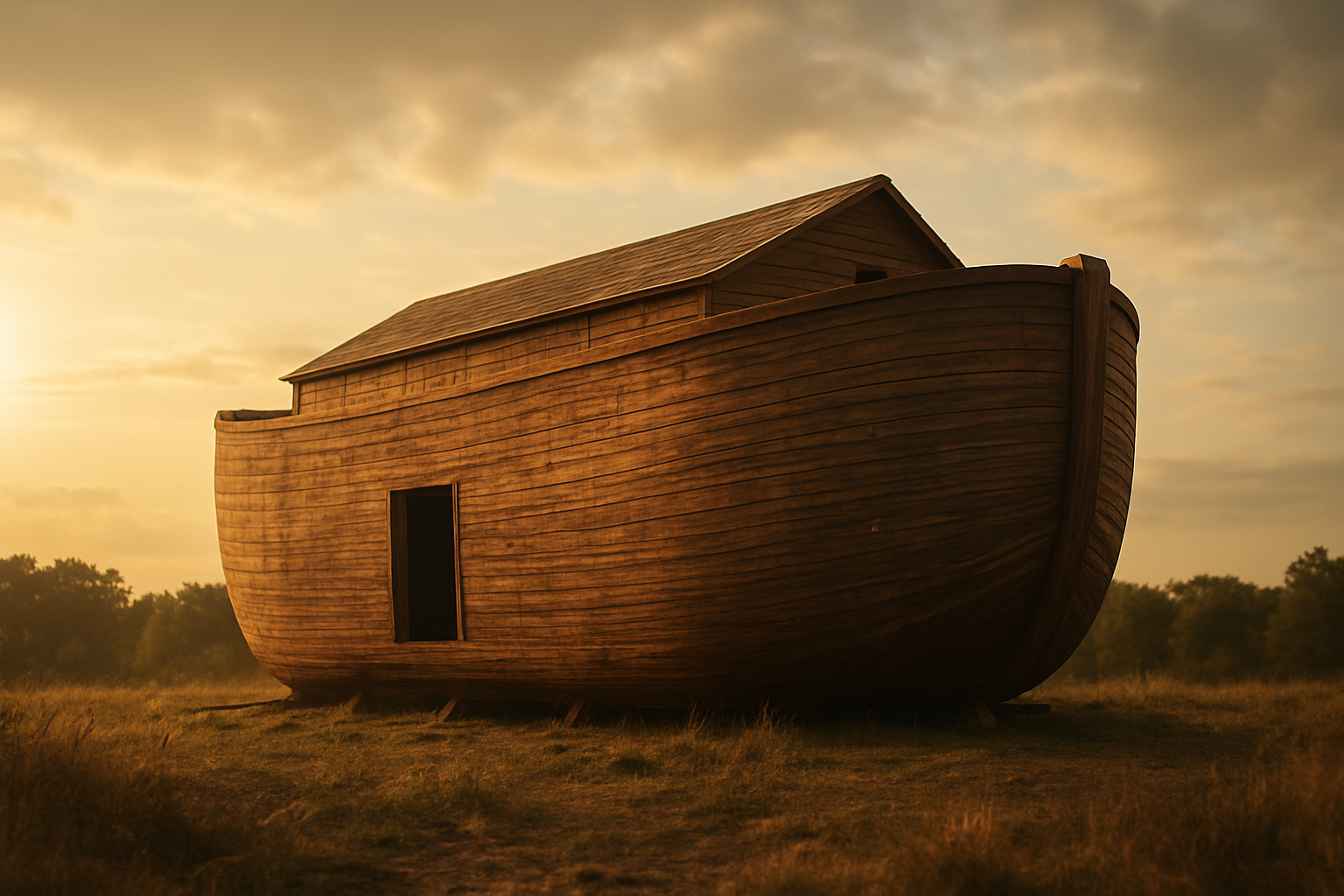
How was Noah’s Ark constructed according to Scripture?
When Genesis gives dimensions, it does more than satisfy curiosity. It roots the narrative in physicality — a wood‑and‑nails, seaworthy vessel meant to carry life through judgment. The text uses the cubit and lists length, breadth, and height with an economy that invites readers to imagine a real, functioning craft rather than only an allegory.
"Make yourself an ark of gopher wood; make rooms in the ark, and cover it inside and out with pitch." — Genesis 6:14
The Bible records practical detail. The measurements and materials matter because they give the ark a functioning shape and purpose in the narrative world: the author expects readers to picture an actual structure able to hold people and animals through a global catastrophe.
Scholars, engineers, and curious observers have debated whether those proportions could be stable. A detail that surprised visitors to modern reconstructions was a lab project where Korean scientists tested model hull shapes and reported that the biblical dimensions offered notable stability and strength. Whether one treats that as decisive proof or interesting correspondence, it shows how the text’s specifics invite technical reflection — and how faith and engineering can converse.
At the same time, faith must resist two temptations. One is reducing the narrative to an engineering manual; the other is dismissing the ark’s physicality as unimportant. The story uses real timber and roofing pitch, and the lives aboard were messy and human.
We also face a pastoral snag when people caricature the account as a "floating bathtub." That phrase, used by some modern skeptics, misunderstands the text and underestimates the problem it was meant to solve: real rescue from a judgment that is both moral and cosmic.
Behind the Words: Genesis 6–7 records God’s command to Noah to build the ark from a particular material and to specific measurements. In its ancient Near Eastern setting, lists of dimensions conveyed reliability and instruction—not mere ornament.
The Heart of It: God’s instruction to build an ark shows divine care for both justice and preservation — He judges sin but provides a tangible means of rescue.
Try This: Picture the smell of tar and wet wood as the animals settle into stalls. Imagine Noah checking a beam, fingers sticky with pitch, praying for the world he loved — and for the strangers seated beside him.
One common misunderstanding treats the ark’s measurements as a modern engineering problem to disprove the narrative. The passage’s primary aim is theological: to show God’s provision and the seriousness of human sin, not to supply a naval architecture textbook.
What was the historical context of the Ark and Noah’s world?
Understanding the ark means listening to the story’s stage directions. Genesis hints that people lived in cities; language and nationhood formed after judgment; family lines spread over the earth. Those are short phrases that point to social realities, not vague myths. The account speaks of moral corruption, increasing violence, and a Creator who responds.
"By faith Noah, being warned by God concerning events as yet unseen, in reverent fear constructed an ark for the saving of his household." — Hebrews 11:7
The Bible speaks into history and community. Hebrews reads Noah theologically: his building was an act of faith in a world that thought differently. That shows us faith lives in time and responds to culture, even when the culture grows hostile.
Genesis also offers a brief ethnography: after the flood, nations spread from Noah’s family and were then divided at Babel. That detail explains both unity and diversity in the human story. We are not meant to picture prehistoric cavemen wandering aimlessly; Genesis suggests ordered societies already existed, with families, cities, and technology. Modern readers sometimes object to caricatures of pre‑flood people as "stupid grunting cavemen," and Genesis supports their complexity by depicting urban life and moral nuance.
That complexity continues after the ark: the same human heart that resisted God before the flood reappears not long after — a reminder that judgment does not erase the need for redemption. People point to episodes like Noah’s later drunkenness as evidence that the narrative is inconsistent or that Noah was flawless. The text itself insists on realism: Noah is righteous, yet still a sinner — and that honesty frees readers from expecting flawless heroes.
Behind the Words: Genesis places Noah in a relational world where cities, families, and languages matter. The narrative assumes communities and technology, which affects how we read the flood as historical witness rather than an isolated myth.
The Heart of It: The Ark story functions as both catastrophe and covenant: God judges systemic evil yet recommits to preserving and renewing human society.
Try This: Imagine riverbanks days after the waters fall: tents pitched, families trading memories, old arguments resurfacing over shared fields. Picture a child asking a veteran, "Why did God do that?" — and the older generation answering with moral honesty and hope.
A common misunderstanding is to expect that the flood should have permanently purified humanity. It didn’t — because judgment without a changed heart only delays the need for a Savior.
Why so many cultures remember a great flood
Why do more than two hundred cultures tell some form of a great flood? That fact nudges us to ask whether the biblical account stands alone or shares a common memory with many peoples. It’s not proof by itself — shared motifs can arise for many reasons — but the widespread presence of flood narratives invites interpretation and humility.
In family‑oriented museum displays you’ll often see cartoon animals smiling, which is an honest, accessible way to introduce children to narrative. Yet a smiling display can unintentionally downplay the moral severity at the heart of the story. Ancient narratives aren’t simply adventure tales; they probe human responsibility, a scale of justice, and God’s mercy.
Some flood stories include precise details about boats, dimensions, or the sequence of events that match the biblical outline. That’s one reason people pay attention when lab experiments or maritime models suggest biblical proportions make sense. But for faith, what matters most is not a list of matching details; it is the way these stories point us back to moral questions: Who are we? What have we done? Who saves us?
Behind the Words: Many cultures preserved flood narratives as moral and cosmological reflections — not always identical accounts, but communal memories shaped by experience, theology, and storytelling.
The Heart of It: The recurrence of flood stories across cultures is less about uniform detail and more about a universal human intuition: we are vulnerable, we are culpable, and we need mercy.
Try This: Picture a table with a neighbor from another tradition and two mugs of tea. Instead of starting with disagreement, ask gently, "What does your story say about why bad things happen?" Let that question open a way to describe both judgment and grace without rushing to prove every detail.
A common misunderstanding is to treat shared flood tales as proof Genesis is mere myth. Shared memory invites comparison and dialogue — and it pushes believers to be precise theologically and winsome conversationally.
When Scripture and culture collide: learning to speak clearly and kindly
We live where cultural pressure nudges people away from biblical claims. Fear of being called unscientific or mocked can silence Christians, especially when museums, schools, and popular science offer other narratives. That’s why how we tell the Ark story matters.
When we present the story, we have three pastoral responsibilities: tell the truth about God’s holiness and judgment, show the reality of grace in the Old Testament, and explain why faith is not irrational but responsive. The Ark story does all three. It shows God’s intolerance for systemic evil and God’s extraordinary provision for sinners.
"And Noah did all this; he built the ark because he had faith in what was commanded." — Hebrews 11:7
The Heart of It: Faith engages our minds and our hands; it builds when it believes.
Try This: The next time you bring the Ark story into conversation, start small. Invite someone to walk a replica if you can, or describe the smell of pitch and wet wood. Tell the emotional truth: this is a story of guilt and hope, not a tidy triumphalism. Let questions land. Resist the two temptations of defensive proof‑throwing or sentimentalizing the account into childish scenes where "the animals are smiling" and nothing else matters.
People are less persuaded by rhetorical victories than by honest, patient witnesses who can sit with doubt and point to the gospel. The ark points forward to the true rescue we find in Jesus, who meets our guilt with mercy that changes us.
Final words for the road
We cannot shrink the Ark into a parable that means nothing, nor can we make it a museum exhibit that only entertains. The ark is a theological anchor: a built, measured, specific rescue that testifies to a God who judges and saves.
Practice telling it as it is — a story with timber and pitch, with flawed people and divine mercy. When someone asks, "If God is so good, then why flood the earth?" answer with both honesty and hope: God’s goodness includes holiness; His holiness hates sin — yet His goodness goes further and provides a way of rescue. That is the scandal and the beauty at the heart of the Ark.
Return to this story when conversations are hard. Build your witness on truth, humility, and hospitality. And when someone laughs and calls it a "floating bathtub," remember the child pointing at the smiling animals — and choose to tell the fuller story: sorrow for what was lost, thanks for the rescue given, and a steady invitation toward the Savior who finally changes us.
Key Takeaways
- Understanding the importance of faith in a culture that often conflicts with Biblical teachings.
- Recognizing the historical evidences supporting scripture.
- Encouraging community involvement in faith-based outreach.
- Highlighting the necessity of discussing God’s holiness alongside His love.
- Engaging children and families in Biblical stories through interactive learning.
Notable Quotes
"God is holy; he cannot tolerate sin."
"What we're trying to present to people is that this one's real."
"If God is so good, then why flood the earth?"