When the Land Makes the Gospel Real
Stand where Scripture happened and let the stories reshape your faith. How do the Holy Land, Jesus' miracles, and the Great Commission change the way we live?
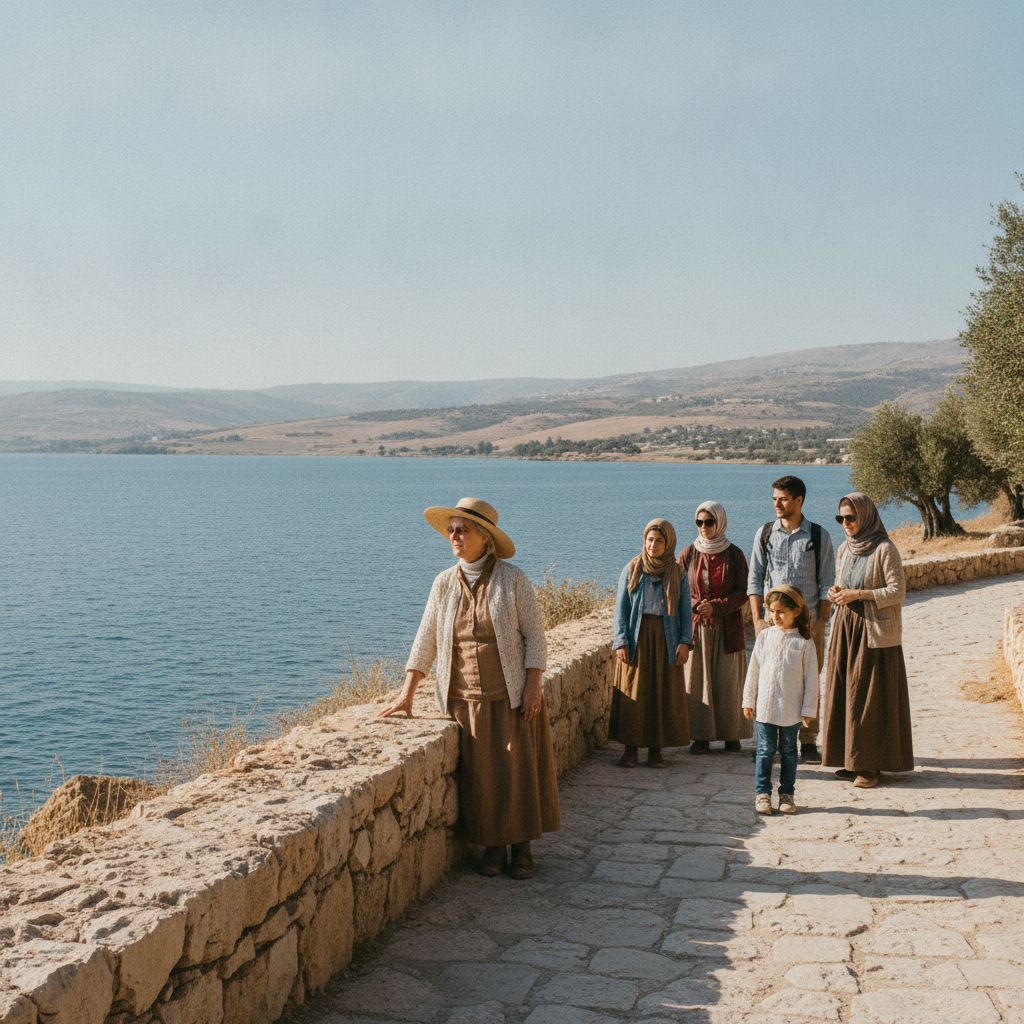
Walking Where the Stories Began
There is a particular honesty that comes when you walk the stone streets mentioned in Scripture. These stones are not museum pieces; they once bore feet that laughed, argued, healed, and mourned. That nearness can make the gospel stop being an abstract truth and begin to rearrange how we live.
"You are the salt of the earth... let your light shine before men, that they may see your good deeds and praise your Father in heaven." — Matthew 5:13-16
Becoming present to Scripture matters. When we stand where Jesus taught on a hillside, the metaphors stop being just helpful images; they become eyewitness anchors for our faith.
- Try walking a familiar passage slowly, aloud, imagining the landscape and the people it held.
Standing on the shore, someone might simply say, "This is the Sea of Galilee right here." That small, direct phrase collapses distance. The knee-jerk fear that the Bible is remote softens.
Picture a father and daughter pausing on a ridge to read the Sermon on the Mount together—two generations, one text, the same breeze. It’s ordinary and human, and yet tethered to something transcendent.
The land forces humility. Geography shapes meaning: a crowd pressing into a house now becomes a narrow doorway and a low roof; boats and storms gain shoreline and wind. This is not travel as trivia. It’s a devotional return—an embodied lectio that teaches our hearts to remember Scripture with bodies, not just minds.
Why Seeing the Holy Land Changes How We Read Scripture
When you stand facing the Sea of Galilee, you can almost measure the distance between shore and shore with your breath. The story of the storm becomes oddly immediate: experienced fishermen, a sudden wind, and a sleeping presence in the stern.
"He arose and rebuked the wind, and said to the sea, 'Peace, be still.' Then the wind ceased and there was a great calm." — Mark 4:39
Presence is more powerful than panic. Knowing the setting clarifies how extraordinary Jesus’ words were—the calm didn’t come because the sea always obeys; it came because He spoke.
- Try imagining the splash of spray, the creak of timbers, the cold water on your shins as faith replaces fear.
There’s a line that lands like a stone: "Don't you even care that we're about to die?" Picture the disciples—seasoned sailors—filing from fear into desperation. That raw question reveals how faith and doubt coexist; it lets us stop pretending the faithful never tremble.
Behind the Words: Mark wrote this Gospel for communities living amid chaos—people who needed to know that Jesus’ authority extended over nature and, by extension, over the turmoil in their lives.
The Heart of It: Jesus' power over the storm shows that our deepest fears are not outside the reach of his voice.
Try This: Picture yourself in a small boat, night thick and the waves high. Speak aloud the one truth you cling to—then listen. Let the memory of a calm sea reshape the posture of your next anxious moment.
One of the most arresting, tender details is how faith sometimes looks messy: friends so determined to get someone to Jesus that they "start taking the roof up." That image teaches that faithful creativity matters more than polite passivity. We are called to be people who move roofs so grace can enter.
What Jesus' Miracles Teach Us About Fear and Faith
Miracles in Scripture are not magic tricks; they are signposts. They point to identity: who Jesus is and what the kingdom looks like when heaven bends toward earth. Standing where healings and exorcisms occurred, we see that compassion often preceded demonstration—mercy paved the way for wonder.
"He said to the crippled man, 'I tell you, get up, take your mat and go home.' He got up and took his mat and walked out in full view of all." — Mark 2:11-12
Compassion comes before competence. The Gospel’s miracles invite trust in a Savior who is attentive to personal need, not a showman performing to impress.
- Try watching for small, ordinary opportunities to offer practical help this week—a neighbor, a co-worker, a family member.
We must face a hard saying that cuts past pastoral comfort: we cannot save ourselves. That bluntness is not meant to shame us into despair but to point us to dependence. The cross—Golgotha’s lonely hill—reminds us that rescue came from outside our capacity.
There is sorrow on that hill and then triumph at the empty tomb. "He is not here. He is risen." Those words turn tragedy into the hinge of the world. Seeing the place where Christ was laid and hearing the proclamation of resurrection make our hope less abstract; it becomes a present, visceral confidence that death does not have the final word.
Behind the Words: The resurrection accounts were written by eyewitness-informed communities that needed to proclaim a living Lord to confront despair.
The Heart of It: Resurrection changes everything—it validates Jesus' identity and the reliability of His promises.
Try This: On a morning when grief feels heavy, read the empty-tomb account slowly. Imagine the stone rolled away, the linen cloths lying by themselves. Let the surprise of the discovery unsettle your certainty that sorrow has the last say.
A common misunderstanding reduces miracles to mere moral lessons. In context, miracles are both compassion and proof—God entering history to restore it.
How the Great Commission Shapes Daily Life
There is a hill outside a city where, according to the Gospels, a last charge was given: go into the world and tell what you have seen. When you stand in that geography, mission stops sounding like an optional program and becomes a tidal identity.
"But you will receive power when the Holy Spirit comes on you; and you will be my witnesses... to the ends of the earth." — Acts 1:8
Mission begins with presence and proceeds by prayer. We are sent from places of encounter; our witness is shaped by what we have seen and who we have become in those encounters.
- Try speaking of one specific thing God has done for you this week—with clarity, brevity, and honesty.
The Great Commission is not a postal-code assignment for professionals only. It’s the rhythm of being a disciple: begin locally—our neighborhoods, workplaces, families—and move outward. That father-and-daughter walk, hands on a map, is itself missionary training: the next generation learns that Scripture is something to carry into life, not just admire.
Mission uses new tools in new eras. The earliest witnesses moved by foot and boat; today our witness can travel across screens into homes we cannot visit. The form changes, not the mandate. We still speak of a life changed by a risen Savior.
The invitation remains open. Questions like "Have you ever asked Christ into your heart?" are not slogans but invitations for transformation. If we have been rescued by the cross and the empty tomb, then going and telling is how grace finds more homes.
We go because we were first sought. The land where Jesus walked helps us read Scripture with eyes that remember texture, weather, and gravity. It teaches that miracles were real acts of mercy and authority, and that mission springs from meeting a living Lord.
So take one small next step. Pause, read a passage slowly, picture the place behind the words, and then speak one simple sentence of the gospel to someone who needs to hear it. We do this together—one faithful, awkward, holy step at a time.
Key Takeaways
- The Holy Land offers a unique perspective on biblical stories.
- Family connections can deepen one’s faith journey.
- Engaging with scripture can be transformative.
- Understanding Jesus’ teaching within the context of His life is important.
- The invitation to faith is always open.
Notable Quotes
"When Jesus journeyed throughout Israel, it was by foot, by donkey, or by boat."
"He is not here. He is risen."
"Have you ever asked Christ into your heart?"