Sketching Pumpkins: Practice, Reference, Purpose
Learn to sketch pumpkins with practical steps, smart use of references, and a rhythm of practice that shapes skill and soul. Pick up your pencil—it's just a sketch.
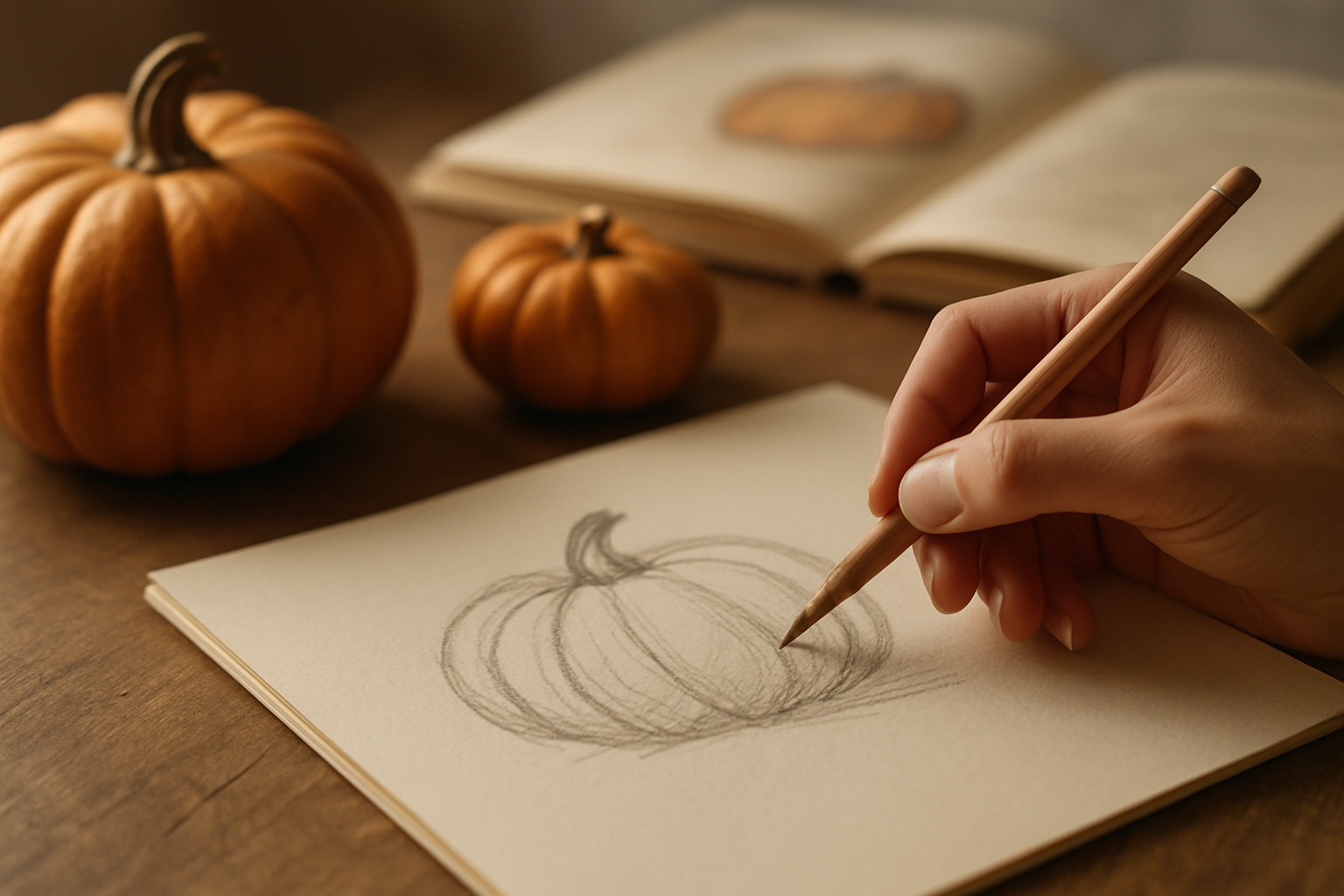
How to sketch pumpkins step by step
Start with simple shapes. A loose oval or circle is fine; let proportion tell the story—one pumpkin bigger, one smaller. Place a light crosshair to find the center of each face and guide where the mouth and eyes will sit. That quick framework keeps features aligned and preserves gesture.
Carve as if you were opening a story. Think in planes: the carved-out eyes and mouth thin as they approach the rind and thicken toward the interior. Use a darker tone inside the cut to sell the three-dimensional illusion. Add short curved groove lines that follow the pumpkin's contour; these suggest volume more convincingly than a single outline.
The Heart of It: Creativity is a spiritual gift that learns shape through discipline and service.
Give space to be simple before you refine. The first pass captures gesture and tone; refinement arrives from repetition, not perfection. Try making the mouth a single bold shape first, then add small teeth later.
Behind the Words: Exodus names artisans filled with the Spirit—Bezalel and his companions—appointed and gifted to craft the tabernacle. That context shows God values skilled hands formed to serve the community: craft as worship, not merely self-expression.
Try This: Imagine gifting a simple card to a neighbor; sketch the pumpkin with emphasized grooves and shade the inside of the carved mouth so it reads from across the room.
Now add personality. Play with asymmetry—the little pumpkin can have one eye deliberately larger than the other, which instantly creates charm. Shade under each pumpkin so it "doesn't stand up" on the page; a small ground shadow anchors the characters to reality.
Finish with a flourish: a curlicue vine or tiny leaf acts as punctuation. Sign and date; this is both a record and an act of stewardship. Keep one sketch for reference and give another away. Small rituals form habits.
Why use references when you draw
References sharpen judgment. Looking at real pumpkins shows they are not perfectly round and their grooves vary in depth and rhythm. A quick observation in a grocery aisle or a photo recalibrates your expectations so your cartoon feels both believable and fresh.
References also teach choices. Study a stem and you notice irregularities you can exaggerate for character. Watch how light falls on a glossy curve and you learn where highlights belong. Those observations translate whether you work with pencil, marker, or paint.
The Heart of It: Wise artists learn to see rightly before they invent wildly.
Observation precedes invention. Faithful details give stylized drawings weight and credibility. Start each sketch session with a two-minute study of a real object or a photo.
Try This: Draw three thumbnails from a single reference—one literal, one simplified, and one exaggerated. Notice what you keep and what you discard. That discernment is the heart of style.
Practical tools follow the eye. Many artists note that digital tools can feel like traditional sketching; pastels, watercolors, markers, and pixels each teach something different. Use a quick inked sketch as a base, then add pastel texture for warmth. Treat each medium as a teacher, not a shortcut.
Using reference keeps humility in your process. You learn to borrow truth from creation rather than invent a fantasy that never reads. Over time, reference becomes less crutch and more language—a visual vocabulary that helps you speak clearly.
How steady practice shapes skill and soul
Practice is not a magic wand. It's a discipline that stacks small improvements into noticeable growth. One artist put it plainly: better skill comes because you practice. That blunt truth holds—skill responds to repetition, and confidence follows. But practice is more than muscle memory; it trains patience, resilience, and trust in small progress.
The Heart of It: When we practice as worship, routine gains meaning and our small acts become offerings.
Skill grows in patient, repeated hands. Practice refines judgment, steadies the hand, and matures taste. Set a doable rule: ten minutes of focused sketching a day rather than marathon sessions once a month.
Behind the Words: Colossians urges believers to "work heartily, as for the Lord, and not for men" (Colossians 3:23). That counsel places ordinary labor within the frame of worship—our daily craft becomes an act of attention offered to God, not only a demonstration for others.
Try This: Picture yourself at the kitchen table after a long day, pencil in hand, tracing grooves on a tiny pumpkin sketch. Instead of measuring worth by output, breathe and offer that quiet time to God—an act of presence and a practice of patience.
Another Scripture helps shape seeing. Psalm 19 opens, "The heavens declare the glory of God; the skies proclaim the work of his hands" (Psalm 19:1). Observing creation trains our eye: noticing how light and texture reveal form is itself a way of listening to God through what He has made. This observation grounds both craft and worship.
There is a hard saying to sit with: you don't always have to have something to give. Our productivity-driven culture tempts us to turn every drawing into a product, to monetize every labor or perform for approval. Some drawings exist simply to form us—private prayers, practice, and play. Letting work remain private is a small Sabbath.
Resist the hustle. Keep a sketchbook that nobody sees. Share some pieces, give others away, and let several remain as reference or memory. Over time you'll find a healthy rhythm: craft that serves, art that blesses, and quiet practice that shapes your heart.
We learn to draw pumpkins by combining deliberate technique, faithful observation, and steady practice. Crosshairs guide placement; grooves sell dimension; a small shadow roots the form. Beyond lines and shading, each sketch forms patience and a posture of attention to God's good world.
Pick up your pencil, make a messy first pass, and remember: it's just a sketch. Keep one study for reference and one to gift, and let the rest teach you in private. Date the corner, sign it, then set it down and breathe. Your hands are learning a way of seeing that will bless you and others in ways you cannot yet imagine.
Key Takeaways
- Practice regularly to improve your artistic skills.
- Use imagination and creativity to make art personal.
- Art can serve practical purposes beyond aesthetics.
- Experiment with various styles and mediums.
- Don't be afraid to share your work with others.
Notable Quotes
"Better you get is because the more you practice."
"You don't always have to have something to give to somebody."