Faith, Prosthetics, and the Fight to Live
Wounded lives are rebuilt when faith, skill, and community meet. Discover how Christian prosthetics work and how you can stand with those who refuse to be defined by loss.
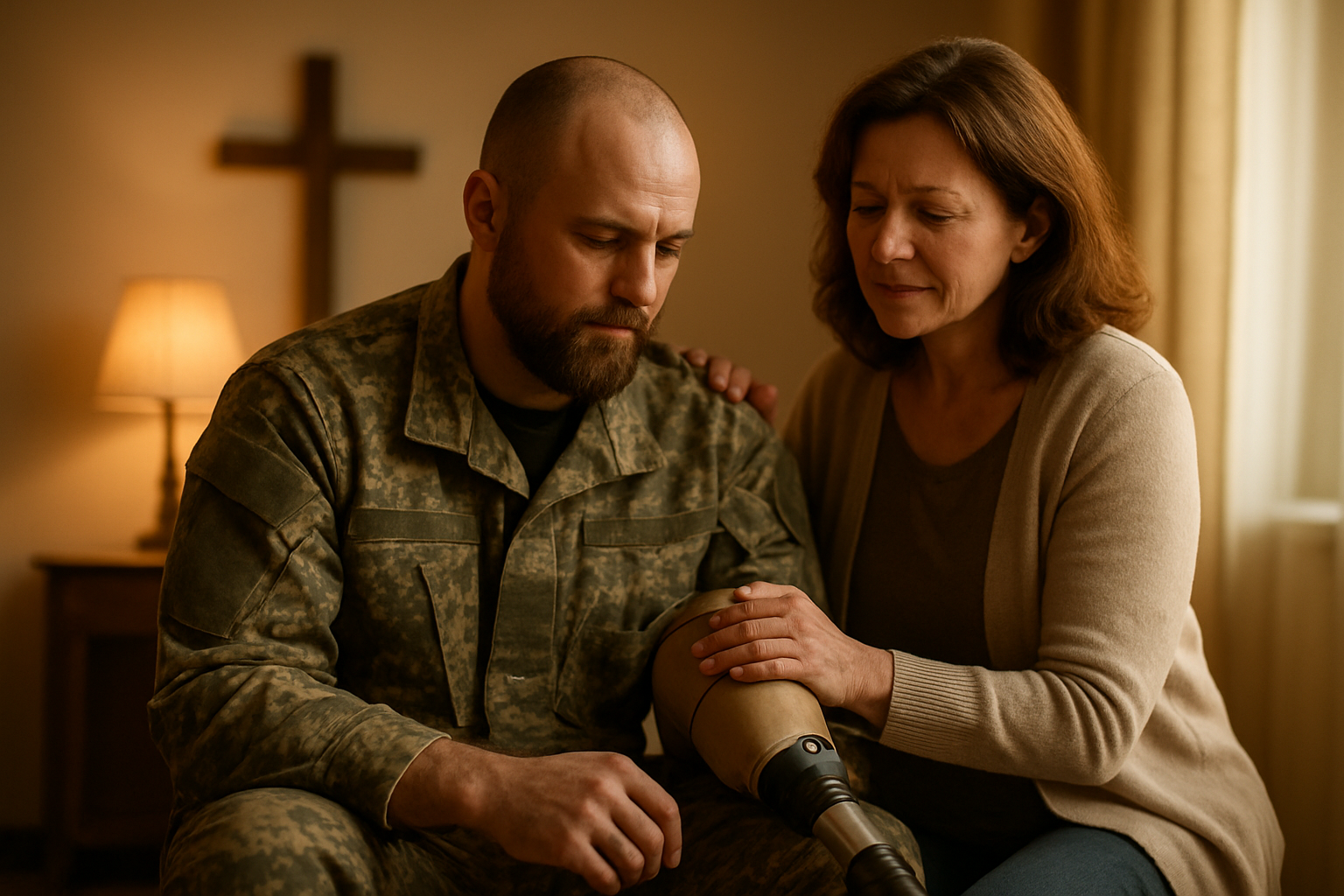
How does faith restore a soldier after catastrophic injury?
A young soldier in his early twenties lay in a hospital bed after an 82-millimeter mortar exploded in front of him. He lost both legs but not his mission. When a loved one kept vigil—feeding him, praying over him, refusing to trade him for ease—the path back to living began.
This is not romanticizing suffering. It is naming how faith and faithful people create a corridor for healing. Many who come through such trauma describe a small, decisive moment: first breath after surgery, first transfer to a chair, first awkward step with a prosthetic. Those moments are spiritual and physical at once.
The Heart of It: Faith anchors rehabilitation in dignity.
Faith gives language to the why; skilled care gives the how. That combination keeps a wounded person from becoming merely a patient and helps them become a neighbor, worker, parent, or leader again.
Try This: Imagine standing beside someone learning to walk again—hold their hand through the first wobble, and speak steady hope into their fear.
Inside a Christian prosthetics center, clinicians do more than shape sockets and tune hydraulics. They teach people to live with new limitations and new possibilities. Since 2022, a foundation supporting this work has helped more than 1,000 Ukrainian service members regain mobility, covering travel, fittings, and training needed to return to community life.
The work is part medical, part theological. A patient once told caregivers, "If I had to choose between two evils, it's better him being alive and losing both limbs, than him dead." That hard choosing is real and painful, but it opens space for gratitude and recommitment to life. When someone says, "It was not my time to die," they are not denying loss; they are staking a claim to future purpose.
Teaching Moment: Luke 18:27
Behind the Words: Luke 18:27 was spoken by Jesus after a story about a rich man and the difficulty of entering God's kingdom. Jesus shocked listeners by highlighting God's power to invert human expectations.
"What is impossible with man is possible with God." — Luke 18:27
The Heart of It: God specializes in turning our impossible losses into spaces for new mission.
Try This: Picture the hospital ward—the beeping machines, the sterile light, the prosthetic foot being fitted. Pray for one concrete ability to return: standing to hug a child, tying a shoelace, or walking to the market. Offer that prayer as a petition for usefulness, not simply for comfort.
A clarification: Faith is not a guarantee of health; it is the courage to seek meaning and service even when bodies change.
What does a Christian prosthetics foundation actually do?
A specialized center is a strange sort of chapel—tubs of silicone sit beside prayer cloths, technicians adjust microprocessors while chaplains listen. The Christian prosthetics foundation at the heart of many stories does three things well: it provides cutting-edge fittings, covers travel and financial burdens for complex cases (including arranging trips to the United States for custom-made prosthetics), and holds space for spiritual care.
Patients practice push-ups to strengthen supporting muscles and learn transfers from bed to chair. Occupational therapists prepare some to travel abroad for custom limbs. One service member who survived a direct mortar strike is being readied for such a trip so that his return to home life and service will be functional and dignified.
The Heart of It: Practical compassion requires systems, not just sentiment.
Compassion that changes outcomes builds clinics, trains therapists, and underwrites travel. It makes redemption operational, not merely rhetorical.
Try This: Volunteer or support organizations that pay for prosthetic fittings and rehabilitation. If you cannot give financially, lend a skill—transportation, accompaniment, or a steady meal schedule for recovering families.
The clinicians are blunt about the scale: close to 50,000 Ukrainians have lost limbs since the invasion began. That staggering statistic could anesthetize us—until we meet one person whose life was re-formed: someone learning to eat with a mechanical hand, someone training to navigate life without sight, someone preparing to return to service on prosthetic legs and saying, "The war hasn't ended yet, so we need to keep fighting." Those words are not bravado alone; they are testimony that meaning was recovered.
Practical training and spiritual accompaniment together create a trajectory: from surviving the blast to becoming an intentional agent of restoration for others.
How can we support wounded soldiers and their families in ways that last?
Sustained support looks like relationships, not single acts. It begins with immediate care—covering surgeries, travel, and prosthetic fabrication—but it cannot end there. Long-term recovery needs vocational re-entry, peer support, and spiritual formation.
Think of the person who lost vision and a hand while preparing a drone; therapists fitted him with a mechanical arm and taught him to rebuild his world by touch. This is rehabilitation as gospel work: teaching someone to trust their hands again and helping them find new ways to serve.
The Heart of It: Long-term restoration values vocation and belonging.
Rehabilitation that leads back into community combats isolation and fosters purpose.
Try This: Picture a returning soldier at a small kitchen table, bills spread out like accusations. Invite them into your small group, offer a job lead, or help set up a workshop where they can mentor others who've been wounded.
We can also be a public church that advocates for systemic care: pushing for policies that fund prosthetic technology, ensuring veterans receive vocational training, and supporting organizations that combine medical excellence with spiritual care. A healed limb is only useful when there is a community to walk into.
Teaching Moment: John 3:16
Behind the Words: John 3:16 appears as the compact gospel in the New Testament, spoken in a conversation about spiritual rebirth and God's love for a broken world. In its context, it answers how heavenly things relate to human longing.
"For God so loved the world that he gave his only Son, that whoever believes in him should not perish but have eternal life." — John 3:16
The Heart of It: The gospel frames physical restoration inside an even larger rescue: God gives to restore relationship and hope, not only to fix flesh.
Try This: When you meet a recovering soldier, say what you see—loss, yes, but also resilience. Offer a short prayer of gratitude for life and for future calling. Let the conversation move toward how their gifts might serve others.
A reminder: Physical healing is good, but it is not the be-all; it points us to an ultimate healing that only God completes.
We are called to be neighbors who refuse to let sacrifice be anonymous. When soldiers give their bodies for a nation's freedom, our faith asks something of us in return: steady presence, advocacy for good medicine, and the hospitality to receive transformed lives.
These stories put a face on Scripture. They invite us to walk beside those who say with trembling joy, "It was not my time to die," and to help make that truth visible. The work is costly—sockets, training, travel, counseling—but it is holy work: it restores dignity, purpose, and community.
If you want to help in a way that matters, give to organizations doing both the physical and spiritual labor; write letters of encouragement; volunteer time; and, most importantly, pray—because prayer matches us to the power that moves the impossible into the possible.
The stones of our common life may not literally cry out, but our hands—yours and mine—can become the voices that say, "You are not alone. We will walk with you."
Key Takeaways
- Faith can empower individuals during the toughest challenges.
- Community support is essential for recovery and rehabilitation.
- The importance of prayer and spiritual strength in crisis situations.
- Historical and archaeological evidence can reinforce faith.
- Active participation in advocating for the persecuted can make a difference.
Notable Quotes
"It was not my time to die."
"I'm truly thankful to God for that."
"I think we still need to have faith in God, even though I don't know what God's plan in this moment."