Dinosaurs, Evidence, and the Story We Tell
Explore how artifacts, folklore, and media shape beliefs about dinosaurs. Learn a pastoral approach that honors Scripture, investigates evidence, and teaches discernment.
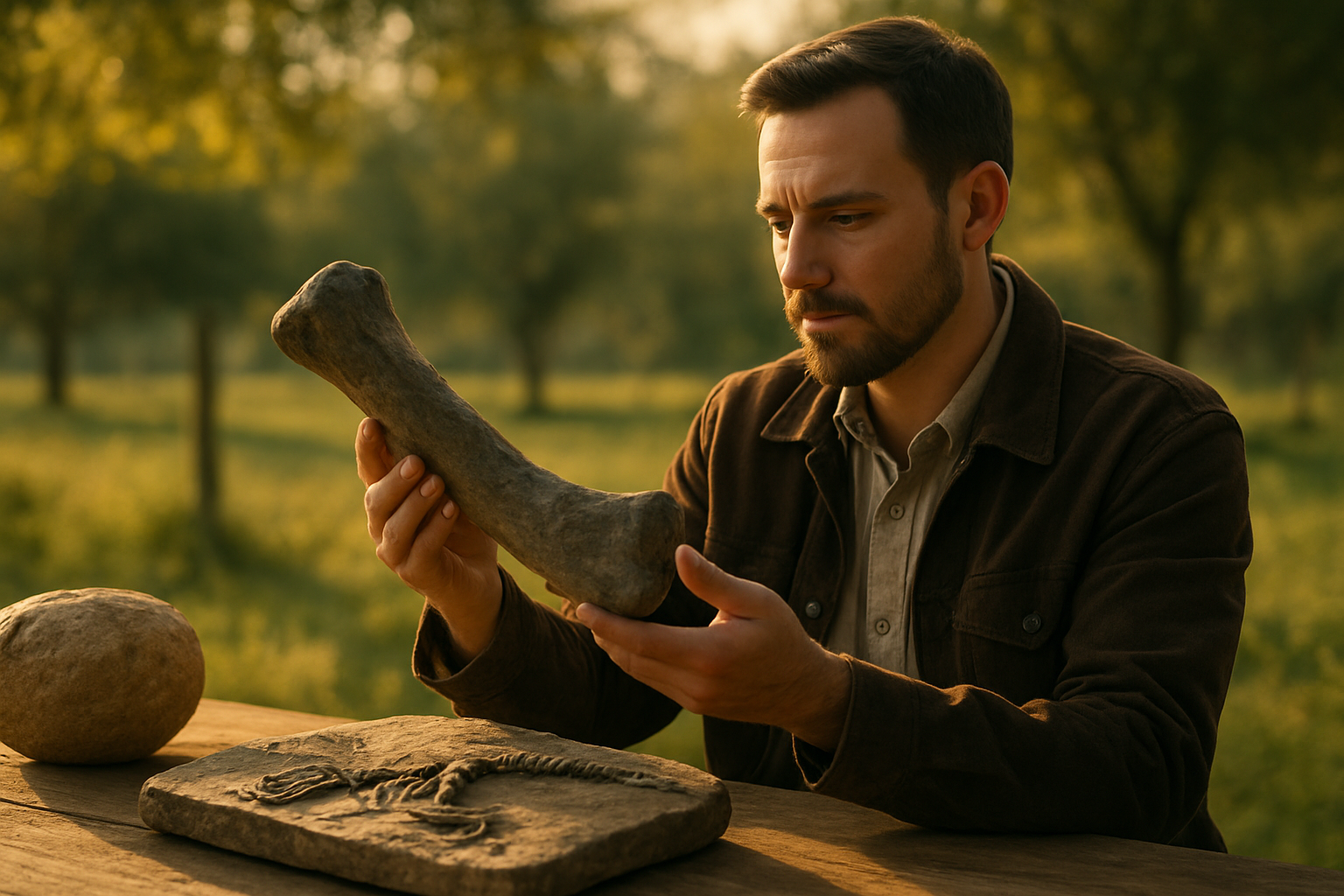
What archaeological evidence suggests humans and dinosaurs coexisted?
Around the world people point to objects and images they read as evidence of humans interacting with creatures that look like dinosaurs. Petroglyphs, carved stones, and textile patterns are offered as windows into how ancient peoples pictured the animals around them. A faint petroglyph at Natural Bridges National Park in Utah and images within the Nazca and Ica collections are sometimes cited as showing creatures with dinosaur-like anatomy.
Artifacts are not neutral; they arrive wrapped in interpretation. Textile patterns or carved stones carry stylistic conventions that can be misread if removed from cultural context. Yet when a community of finds recurs — when similar motifs appear across continents — it presses us to ask honest questions about continuity of memory and observation in history.
The Heart of It: People record what they know; cultural memory matters.
Behind the Words: Isaiah uses vivid, familiar images to describe calamity and threat: "Through a land of trouble and anguish... from which came the lioness and the lion, the viper and the fiery flying serpent." (Isaiah 30:6). In that context the "fiery flying serpent" functions as a terrifying, symbolic image for a people under geopolitical pressure.
The Heart of It: Images of large or fearsome creatures in ancient writing and art often function as theological and cultural symbols, not always as zoological catalogues.
Try This: Picture an ancient villager by candlelight describing a beast that glinted like jewels — not reporting a fossil, but encoding terror, beauty, and memory into a story told to children. When you look at an artifact, ask what story it was telling, and whom it served.
A common misunderstanding is to assume every carved creature equals a literal eyewitness account. Some images are symbolic, some stylized, and some may point to real encounters — discernment matters. When evaluating alleged human–dinosaur artifacts, be patient and exacting. Ask about provenance, context, and consistent patterns of depiction. Be careful with objects extracted from layers without reliable dating or documentation — curiosity must meet rigor.
Why do museums and films present dinosaurs as millions of years old?
Museums and popular media tend to present one dominant narrative: dinosaurs lived tens of millions of years ago and died out long before humans appeared. That narrative is taught in ways that feel definitive to children — labels, museum dioramas, and blockbuster films combine to build a seamless history. Cinematic authority can deliver scientific detail so convincingly that the line between entertainment and settled fact blurs for young learners.
The concern is educational framing. When timelines and taxonomies are presented as unassailable facts, alternative questions and interpretive options are marginalized. A single, consistent worldview can become the default so quickly that opposing views feel like misinformation rather than sensible questions.
The Heart of It: Labels and spectacle can replace curiosity with conviction.
Behind the Words: When a child's first contact with a subject is cinematic certainty, they learn certainty more than they learn how to think. Scientists reconstruct many features — skin color, posture, behavior, vocalization — from limited evidence. Museum mounts and film creatures are informed reconstructions, not photographs of the past.
The Heart of It: Honoring scientific work does not require uncritical acceptance of every reconstruction. It requires humility and an appreciation for the interpretive choices behind reconstructions.
Try This: Invite children to study two reconstructions of the same dinosaur and list what is observed vs. what is imagined. Ask: what assumptions about time, environment, or behavior shaped each reconstruction? Let them sketch alternative versions and defend their choices. This trains both imagination and critical thinking.
When dragons walked with us: folklore, memory, and big creatures
Folklore and myth worldwide preserve images of winged serpents, fire-breathing beasts, and coiled reptiles that glittered like jewels. Travelers and collectors have recorded motifs — in the British Isles, parts of Asia, and indigenous traditions — describing creatures with crests "sparkling with all the colors of the rainbow." These are not modern inventions but stories passed through generations.
Some of these motifs match archaeological finds: carved stones, temple reliefs, and woven textiles sometimes display long-necked or plated creatures that today some viewers interpret as stegosaurs, pterosaurs, or other prehistoric forms. For example, a carving inside a temple at Angkor Wat has been read by some researchers as a stegosauriform figure. Reports of Ica stones, Nazca line imagery, and related travel accounts have also fed the conversation.
The Heart of It: Ancient stories often preserve observations, but they do so in the language of myth and meaning.
Behind the Words: Genesis relates the ark and the saving of living creatures: "He took two of every living creature..." (Genesis 6:19). In its ancient setting the Genesis account functions as a covenantal narrative about survival, judgment, and God’s ordering of creation.
The Heart of It: Scripture treats animals as part of God’s good creation and insists that humans are eyewitnesses within that created order. That claim reframes how we read ancient art and stories: some images may be memory-colored description, others metaphor.
Try This: Picture Noah on the ark, leaning into a stall where a large, unfamiliar beast is tethered — not a museum specimen but a living creature, breathing and observed. What vocabulary would a culture use afterward to describe it? Let that image temper how you read an old carving: could it be memory-shaped description rather than pure myth?
A single carving doesn’t prove coexistence. But repeated motifs across wide geographies — petroglyphs in Utah, textile patterns in Peru, reliefs at Angkor Wat — press us to keep asking honest questions and to avoid dismissive certainty.
How should we teach children about dinosaurs and origins?
Education is pastoral work: you shape hearts as much as minds. When children are told a neat, single story — "dinosaurs lived millions of years ago" — they learn closure instead of curiosity. But filling classroom time with contested claims without guidance is no better. We owe them clear categories: what is observation, what is interpretation, and what is worldview.
Start with what is secure: fossils are real objects, stratigraphy is an observable pattern, and different communities of scientists offer competing interpretations. Then show how presuppositions shape conclusions. Point out when a museum diorama is a reconstruction and when a label is inference. Help children practice critique by comparing reconstructions and asking what assumptions each makes about time, environment, and human involvement.
The Heart of It: Teach children to ask, not only to receive.
Behind the Words: Giving a child the tools to question is a greater gift than forcing agreement. Honest skepticism and faithful curiosity are both God-honoring dispositions.
Try This: Host a family evening: lay out a petroglyph, a museum mount, and a movie still. Ask kids to list what’s observed and what’s imagined. Then invite them to write a short story from the perspective of a child who found a fossil the day after a flood. This trains imagination, discernment, and pastoral sensitivity.
Be ready for pushback. Some will call this skepticism; others will call it defense of orthodoxy. Our aim is neither paranoia nor naiveté. We want young believers to love truth more than the comforting certainty of any one narrative. When someone claims, "we just covered all the evidence that shows they've always lived with man," be honest about limits. Evidence can point strongly one way, but humility keeps us teachable. Train children to recognize robust patterns without concluding that every claim is undisputed.
Stone carvings, folklore, museum mounts, and Hollywood effects all shape how we imagine the past. None of them, taken alone, settles the great questions. Yet when we hold Scripture, archaeology, and careful reasoning together, we can teach a posture of discernment: one that honors God’s Word, respects evidence, and protects the hearts of those we shepherd.
Press into wonder. Ask the hard questions — even the ones that sting — and, with patience, help one another sift image from inference. Teach the next generation to love truth more than certainty.
Key Takeaways
- Be aware of the influence of media on cultural beliefs about science.
- Encourage critical thinking about educational materials regarding evolution.
- Explore alternative interpretations of historical evidence within a biblical context.
- Recognize the importance of understanding various perspectives on controversial topics.
- Engage in discussions that challenge prevailing scientific theories with sound evidence.
Notable Quotes
"We just covered all the evidence that shows they've always lived with man and haven't lived millions of years ago."
"Unlike the evolutionists, we actually tell our young people about the other views on the matter so they can criticize them."