Bethsaida Revealed: Fire, Stones, and Faith
A wildfire revealed ancient Bethsaida along the Sea of Galilee — mosaic, inscription, and inkwell — inviting us to deepen faith, serve the hurting, and heed stones that speak.
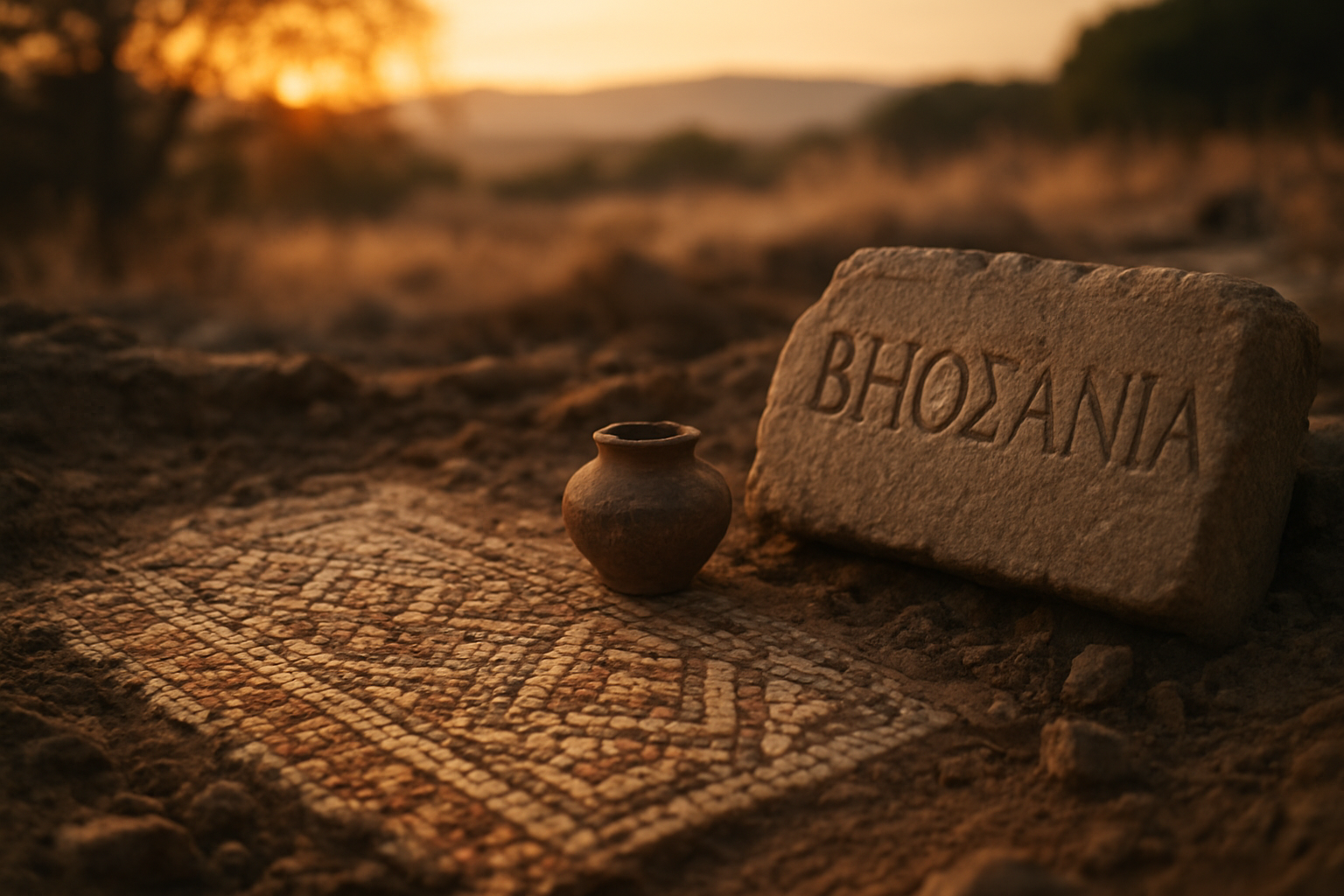
How the wildfire revealed Bethsaida
A wildfire raged for 17 hours along the northern shore of the Sea of Galilee and, when the smoke cleared, unexpected contours of an ancient town lay bare. Burned vegetation and stripped topsoil made features visible that had been obscured for centuries. Where archaeologists had only guessed at walls or streets, the fire exposed stones and the outlines of public buildings.
What the flames exposed was not just debris but story: surface remains from the Roman period, fragments of walls, and pottery sherds scattered like punctuation marks across the parched ground. One striking find was an inscription uncovered beneath a Byzantine church — an inscription honoring Peter as “keeper of the keys.” That mosaic fragment, once hidden beneath later construction, became a hinge between first-century memory and later Christian devotion.
The Heart of It: Fire and loss can become instruments of revelation. Our faith is not threatened by the unearthing of history; rather, history can strengthen the conviction that gospel events happened in real time and place.
- When grief or crisis strip away comforts, we are forced to look more closely at the foundations of our faith.
Seeing the excavation site in its blackened state is like standing in a cathedral after a storm. You can still smell smoke, but now you can trace the footprint of a community that lived, worshiped, and worked on the lake’s edge. You see where fishermen’s weights were scattered; you can pick up an inkwell — a small ceramic cup that says loudly, in the silence of clay, that this village was literate and engaged in business and thought.
A direct phrase from the digging put it plainly: "hidden parts of this biblical village unseen for nearly 2,000 years." Those words are not hyperbole when you stand on the ruined streets; they remind us that God sometimes reveals what has lain dormant for generations.
This moment teaches practical humility. The smoke did not erase history; it peeled back a layer and let scholars and pilgrims alike stand more precisely where gospel stories occurred. For you and me, it’s a call to pay attention — to watch how God uses unlikely circumstances to open our eyes to truth.
Behind the Words:
"Now Philip was from Bethsaida, the city of Andrew and Peter." — John 1:44
John names a town known to readers of the time; it anchors the apostles in a real, geographic community where trade, fishing, and worship intersected.
The Heart of It: A grounded identity matters; our faith is embodied in places and people, not just ideas.
Try This: Picture yourself standing where the fishermen stood, the wind off the lake cooling your face. Ask silently: which part of my faith is rooted in a place I can still touch? What needs uncovering?
Why Bethsaida matters for believers today
Bethsaida appears repeatedly in the Gospels: it’s the hometown of Andrew, Peter, and Philip; it’s near the spot where Jesus fed the 5,000 and where He healed a blind man in a two-stage, intimate encounter. Finding physical traces of such a community helps us read the Gospels not as abstract theology but as events that unfolded in streets, synagogues, and homes.
When excavation teams found a mosaic inscription beneath a Byzantine church referring to Peter as the “keeper of the keys,” that detail resonated across both archaeological and devotional lines. That mosaic is more than an artifact; it is a witness to a continuous memory — communities remembering who came from these places and why they mattered.
The Heart of It: The gospel is rooted in actual time and space. Knowing the setting of Jesus’ ministry helps us read Scripture with fresh eyes and deeper compassion.
- When Scripture moves from abstract to concrete, our faith gains texture and urgency.
Imagine entering what may have been a simple house, now outlined by foundations and broken tesserae. You crouch and find glass beads that once threaded a woman’s hair. You brush aside soil and see an inkwell — proof that literacy wasn’t the exception but a presence in this lakeside village. Such small details push back against caricatures of Galileans as uneducated or uncultured. They invite us to see the disciples as real people, embedded in a community where trade, ritual, and learning met.
A brief teaching moment here helps us go deeper without losing the pastoral beat.
Behind the Words:
"Once more Jesus put his hands on the man's eyes. Then his eyes were opened, his sight was restored, and he saw everything clearly." — Mark 8:25
Mark records a unique two-stage healing in Bethsaida: partial sight followed by full sight after another touch. That context suggests a patient, relational ministry rather than spectacle.
The Heart of It: Healing often unfolds in stages; God’s work is intimate and gradual, not always instantaneous.
Try This: Picture the blind man sitting by the lake, someone guiding his hand to a fisherman’s net. Now imagine Jesus leading him out of the village — a slow, steady restoration. In your life, name one place where healing has been incremental, and thank God for the steady touch.
This is not archaeology for archaeology’s sake. It’s archaeology that deepens worship. When we read of Simon Peter leaving nets to follow Jesus, the stones and potsherds make that choice more vivid. They don’t replace the Holy Spirit’s witness; they amplify the gospel’s rootedness.
How communities endure amid conflict
If stones cry out, communities still find ways to speak love into dark places. The same region that yielded ancient inscriptions is also living memory for modern families wounded by violence and displacement. People there pivot from normalcy to crisis on a dime, organizing shelters, trauma therapy, meals, and emergency care.
The living city is not merely a museum. It is a place where human lives are fragile and brave. The response of neighbors — dropping everything to help a family of hostages or building a bomb shelter — shows a social muscle forged under pressure. It’s not synthetic resilience; it’s learned, communal faith made concrete.
The Heart of It: Faith shows up as service in crisis. When communities are tested, their true theology is revealed not in words but in actions.
- Practical care — cooked meals, a safe bed, counseling for trauma — is where theology meets the poor and frightened.
Picture a small neighborhood center converted into a meeting place for families waiting for news. Prayer groups form naturally; strangers sit together and share what little they have. Volunteers coordinate supplies, and a social worker offers a quiet space for someone to weep. That is the church in neighborhood form: messy, costly, transformational.
A witness from the field presses this: "the stones still cry out, testifying to the truth of the gospel." That phrase can feel poetic until you see a burned site where locals gather to pray, where an inscription calls Peter the “keeper of the keys,” and where an inkwell proves people read and wrote. The stones speak — but their voice should drive us to pastoral urgency.
Pastorally, the danger is treating archaeology as an excuse for complacent spirituality. The stones do not save; Christ does. Yet the stones call us to stewardship: to protect heritage, to serve the living, and to remember that faith without works is a dead thing in a fragile world.
Faith, stones, and service: bringing the discoveries home
We can let a broken landscape be only a spectacle, or we can let it shape discipleship. The finds at Bethsaida — Roman-period walls exposed by fire, the mosaic inscription naming Peter the “keeper of the keys,” the inkwell that whispers of literacy — are not curiosities to shelve. They are invitations.
They invite us to behold the incarnation in context: Jesus taught and healed in villages of real people with routines and rituals. They invite us to tend the living stones of our neighbors — the refugee, the widow, the family in trauma — with the same care the archaeologist brings to a fragile tessera.
The Heart of It: History and compassion work together to strengthen faith. Knowing where Jesus walked should move us to walk with those who carry present-day burdens.
- Begin by listening: to local stories, to the pain in your neighborhood, and to the ways God might be calling you to act.
Try This: Go to a local historical marker, a churchyard, or an archaeological display. Stand silently for five minutes and pray for the people who lived there. Then ask, Who in my community needs shelter, a meal, or just to be heard? Make one call. Deliver one dish. Let ancient stones produce modern mercy.
If the ashes and the mosaics teach us anything, it is this: God is bigger than destruction and more creative than our grief. The hand that moves history also moves hearts. The same region that saw a two-stage healing and the feeding of the 5,000 now teaches us how to hold memory and mercy together.
We do not worship artifacts; we worship the God who made the world in which those artifacts were formed. But when the ground gives up its secrets — when "hidden parts of this biblical village unseen for nearly 2,000 years" emerge — we should listen. The stones speak, and their testimony should awaken in us a deeper love for truth and for neighbor.
Key Takeaways
- Archaeological findings can reinforce faith and provide historical context.
- Community resilience is crucial in the face of conflict.
- The significance of biblical sites continues to resonate today.
Notable Quotes
"It's the only place where it is mentioned as the keeper of the keys."
"The stones still cry out, testifying to the truth of the gospel."